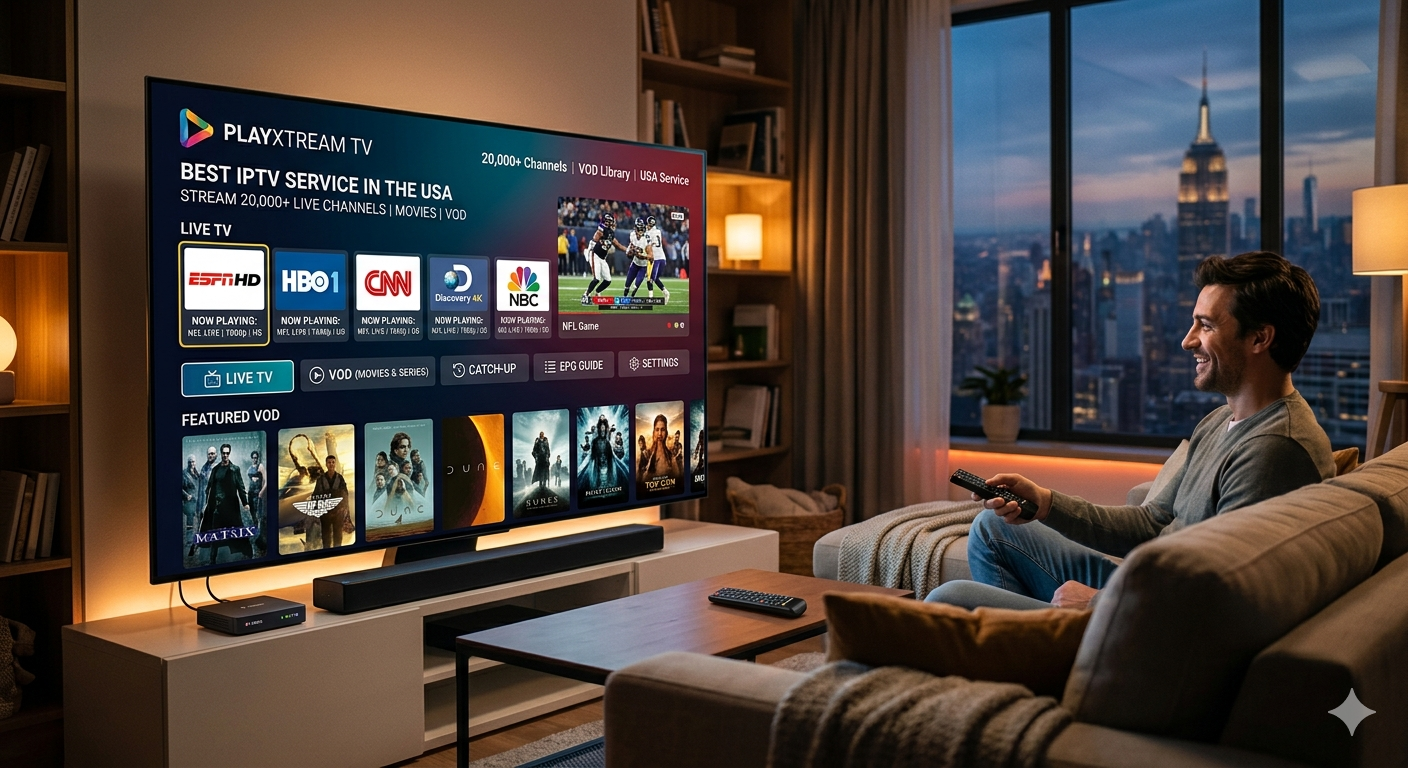
What is IPTV? Simply put, it is television delivered over your internet connection instead of cable or satellite. Wondering what is IPTV? Learn how it works and how to set it up. Stream 20,000+ live channels on any device with PlayXtream TV — best IPTV service in the USA.
Table of Contents

This post will explain how IPTV works, the main service types you’ll encounter, and the technology that makes streaming possible. You’ll also see the key benefits and practical limits, where businesses and consumers use IPTV today, and what the market looks like next—so you can decide whether switching makes sense for your setup.
Understanding what is IPTV helps you make the right choice when switching from traditional cable TV. What is IPTV and How Does It Work?Core Technology and Transmission Methods
IP networks carry compressed video packets to your device, use different streaming modes for live and on‑demand content, and rely on distributed servers to reduce latency and buffering.
Internet Protocol Basics
IPTV sends video as IP packets over broadband networks, not as radio waves or satellite carriers. Your provider’s headend ingests sources (satellite feeds, live encoders, VOD libraries), transcodes them into codecs like H.264 or H.265, and encapsulates streams into MPEG-TS or fragmented MP4 for delivery.
Routing and addressing use standard TCP/IP and UDP. Multicast over IGMP or PIM is common for live channels to minimize bandwidth on managed networks. Unicast (HTTP/TCP or UDP) serves individual VOD sessions and authenticated streams. Your home router and set‑top box (or app) reassemble packets, decode video, and render it on screen.
Quality depends on packet loss, jitter, and available throughput. Network QoS, adaptive bitrate support, and buffering strategies directly affect playback smoothness.
Streaming Techniques
IPTV uses two principal streaming modes: multicast for linear TV and unicast for video‑on‑demand.
Multicast sends a single stream to many subscribers simultaneously, conserving bandwidth for live channels. It requires provider and network support (IGMP snooping, multicast routing) and often runs on managed operator networks rather than the public internet.
Unicast delivers a separate stream per viewer, enabling VOD, start/stop, and time‑shift features. Unicast common protocols include HTTP-based adaptive bitrate (HLS, DASH) which switch between quality levels based on your real‑time throughput. RTP/RTSP or UDP may appear in lower‑latency deployments.
Both modes use buffering and error correction: RTP with FEC for low latency, or ABR with CDN caching for resilience. Authentication and DRM integrate into streaming to control access and content rights.
Content Delivery Networks
CDNs place cache servers close to end users to lower latency and reduce backbone load. Your IPTV provider either operates its own CDN or leases capacity from commercial CDNs to serve VOD and catch‑up content.
Edge caches store segmented video files (HLS/DASH) and respond to HTTP range requests, speeding startup and enabling higher bitrate variants. For live IPTV, origin servers push segmented chunks to edge nodes or rely on multicast within the operator network with CDN edges handling regional distribution.
CDN metrics—cache hit ratio, time to first byte (TTFB), and regional throughput—directly affect your viewing experience. Providers also use load balancers, geo‑DNS, and TLS termination at edges to ensure secure, reliable delivery.
Types of IPTV Services
What is IPTV Live TV? It streams real-time broadcasts directly to your screen via IP networks. IPTV delivers channels and on-demand libraries using IP networks, letting you pick between real-time broadcasts, rented or purchased content, and shifted viewing of scheduled programs. Each service type uses different delivery methods and suits different viewing habits, devices, and bandwidth profiles.
Live Television
Live Television streams real-time broadcasts of events and scheduled channels over IP. You get the same experience as traditional cable for news, sports, and channel lineups, but delivered via multicast or managed unicast to reduce bandwidth for many simultaneous viewers.
Providers typically use protocols like IGMP for multicast or HLS/DASH for unicast streams; this affects latency, channel zapping speed, and network load. You should expect features such as electronic program guides (EPGs), channel grouping, and regional feeds.
Live IPTV often requires higher, more consistent upload and download quality from the provider and stable downstream bandwidth on your end, especially for HD and 4K channels. Devices range from provider set-top boxes to smart TVs and mobile apps, and many operators add DVR and pause/restart options to improve the live experience.
Video on Demand
Video on Demand (VOD) gives you access to a library of movies, series, and other recorded content that you can play anytime. Unlike linear channels, VOD uses on-demand streaming over HTTP-based protocols (HLS/DASH), letting you start, stop, and seek instantly.
Catalogs may be subscription-based, transactional (rent/buy), or ad-supported; metadata, thumbnails, and personalized recommendations help you find content quickly. Content delivery networks (CDNs) and adaptive bitrate streaming optimize playback across varying network conditions.
For best results, ensure your connection supports steady throughput for chosen resolution and that your device supports the service’s DRM and codecs. Many IPTV platforms combine VOD with live channels and user profiles to create a unified viewing experience.
Time-Shifted TV
Time-Shifted TV lets you watch broadcast content after it airs or restart live programs from the beginning. Common forms include catch-up services (hours or days of recent shows) and network DVRs hosted in the cloud.
This service hinges on recording and storage infrastructure at the provider side, plus EPG integration so you can select past broadcasts or schedule recordings. Time-shifted features reduce the need to match your schedule to broadcasts and are especially useful for sports highlights, missed news, and episodic catch-up.
Expect limits such as retention windows, per-title availability, and sometimes regional rights restrictions. You should check provider policies on recording length, simultaneous streams, and exportability if you require long-term access to recorded content.
Key Benefits and Advantages
What is IPTV without flexibility? With PlayXtream TV you get 20,000+ channels on any device. IPTV gives you control over what, when, and where you watch by combining live channels with on‑demand libraries and device flexibility. Expect interactive features, personalized recommendations, and the ability to stream the same account across phones, tablets, smart TVs, and set‑top boxes.
Interactivity and Personalization
IPTV lets you pause, rewind, and restart live broadcasts so you never miss key moments during a game or news bulletin. You can also use time‑shifted TV and cloud DVR to record shows to your account and access them later from any device.
Personalization uses viewing history and explicit preferences to surface channels and on‑demand titles you’re likely to watch. That reduces searching and helps discover niche content—local channels, language‑specific playlists, or genre collections tailored to your family.
Interactive menus and apps add features like multiple camera angles for sports, real‑time stats overlays, and clickable program guides. These tools make IPTV more responsive to your habits compared with traditional broadcast TV.
Multiscreen Access
With IPTV, your subscription works across a mix of devices: smart TVs, streaming sticks, Android/iOS phones, tablets, and PC browsers. You can start a show on your living‑room TV and continue on your commute without re‑booking or losing your place.
Network adaptive streaming (adaptive bitrate) adjusts video quality automatically to match your current bandwidth, which helps maintain playback on mobile networks and variable home connections. Many services also allow simultaneous streams, so different household members can watch different channels at the same time.
Account management typically includes user profiles and parental controls, so you can limit content per profile while keeping billing centralized. That makes IPTV practical for households with diverse viewing needs and devices.
Challenges and Limitations
IPTV relies on your internet connection and network design, which creates constraints around capacity and consistent delivery. Expect issues tied to bandwidth supply and service-level guarantees that affect viewing, recording, and interactive features.
Bandwidth Demands
IPTV streams consume significant downstream bandwidth, especially at high resolutions like 1080p or 4K. A single 4K stream can require 15–25 Mbps; multiple concurrent streams in a household or a neighborhood can quickly saturate residential links or shared ISP backhaul.
You must account for peak usage periods. During evenings or major live events, contention on last-mile links and ISP aggregation points can cause buffering or forced quality drops. Providers use multicast, adaptive bitrate streaming, and CDN caching to reduce load, but those solutions require compatible network hardware and higher operational costs.
Mobile or metered connections pose extra limits. Data caps, variable cellular performance, and Wi‑Fi congestion inside your home can all change the effective bandwidth available to IPTV devices.
Quality of Service Issues
IPTV depends on low latency and predictable packet delivery to maintain audio/video sync and channel zapping speed. Packet loss, jitter, or latency spikes introduce artifacts, freezes, or audio dropouts that degrade live and on‑demand experiences.
You can mitigate problems with QoS policies, traffic shaping, and dedicated IPTV VLANs on managed networks. However, QoS requires coordination between your home router, ISP equipment, and the provider’s delivery network. Where that coordination is missing, you’ll see inconsistent performance.
Encryption, DRM, and multicast-to-unicast conversions can add processing delay and increase error sensitivity. Also, legal and rights-management restrictions sometimes force rerouting or transcoding that further affects latency and picture quality.
Common Applications Across Industries
IPTV delivers live channels, on-demand video, and interactive features over IP networks, helping you replace legacy distribution, add personalized services, and reduce costs. It shifts content control to your network, enables analytics, and supports multi-screen delivery across homes, hotels, and corporate or education environments.
Residential Use
You can use IPTV to stream hundreds of live channels and VOD libraries to smart TVs, set-top boxes, phones, and tablets. Providers often deliver channel lineups via multicast (for live TV) and unicast (for VOD), so your router and ISP connection determine picture quality and channel stability.
IPTV adds features that cable rarely offers: time-shifted viewing, start-over, cloud DVR, and user profiles with parental controls. You can also integrate recommendation engines and EPG (electronic program guide) data for faster discovery.
For practical setup, you’ll need a subscription, compatible client apps or an STB, and adequate upstream/downstream bandwidth—typically 5–10 Mbps for HD and 25+ Mbps for multiple concurrent 4K streams. Security options include DRM, secure tokens, and authenticated sessions to protect paid content.
Hospitality and Hotels
In hotels, IPTV replaces legacy coax systems to deliver branded TV portals, guest info, and on-demand content on in-room TVs. You can present customized welcome messages, room service menus, and billing integration directly on the TV, improving guest experience and upsell opportunities.
Operators use centralized content management to push updates and regional channels while maintaining compliance with licensing. IPTV supports pay-per-view, pay-TV packages, and multi-language guides, letting you differentiate room categories or loyalty tiers with bespoke content bundles.
Network design focuses on reliability and isolation: guest traffic should run on a segmented VLAN with QoS policies to prioritize live channels and VoIP. Integration with property management systems (PMS) and analytics helps you track viewing patterns and monetize services.
Corporate and Education
You can deploy IPTV to stream internal broadcasts, training, town-halls, and lecture capture across campuses or offices. It scales from department-level multicast for live all-hands to on-demand libraries for compliance training with access controls tied to your directory service.
In education, IPTV supports classroom recording, remote lectures, and digital signage. Students can access recorded lectures on-demand, and instructors can push real-time polls or Q&A through interactive clients.
Enterprise deployments emphasize access control, logging, and content lifecycle management. Use single-sign-on, role-based permissions, and WAN-optimized delivery (CDN, caching) to keep bandwidth costs predictable while ensuring secure, auditable distribution.
Market Trends and Future Outlook
Now you know what is IPTV and how it can replace your cable subscription — try PlayXtream TV free today.IPTV adoption is expanding through tighter device integration and shifting revenue models, driven by higher-resolution streams, personalized recommendations, and telco investments. You’ll see platforms emphasize low-latency delivery, app ecosystems, and flexible pricing to compete with OTT players.
Integration with Smart Devices
You will access IPTV more often through smart TVs, streaming boxes, and mobile apps that support 4K/8K, HDR, and low-latency protocols. Manufacturers embed IPTV apps and APIs in smart TV firmware, enabling channel guides, catch-up TV, and unified search across live and on-demand catalogs.
Expect tighter interoperability with voice assistants and home hubs, so you can change channels, request recordings, or ask for personalized recommendations by voice. Network-aware features such as adaptive bitrate streaming and QoS tagging improve playback on variable home broadband. For providers, this means building lightweight SDKs and certification programs so apps perform reliably across dozens of device models.
Evolving Business Models
You’ll encounter a mix of subscription, hybrid, and ad-supported IPTV offerings that target different user segments. Traditional telcos bundle IPTV with broadband and mobile plans to reduce churn, while OTT-first entrants offer à la carte channel packs and micro-subscriptions for niche content.
Advertising is becoming more programmatic and dynamic within IPTV streams, with targeted ad insertion tied to household profiles and viewing behavior. Pay-per-view and transactional VOD remain important for live sports and premium events. Providers must balance licensing costs, churn management, and ARPU growth while offering free trials, tiered pricing, and loyalty incentives to attract and retain subscribers.